

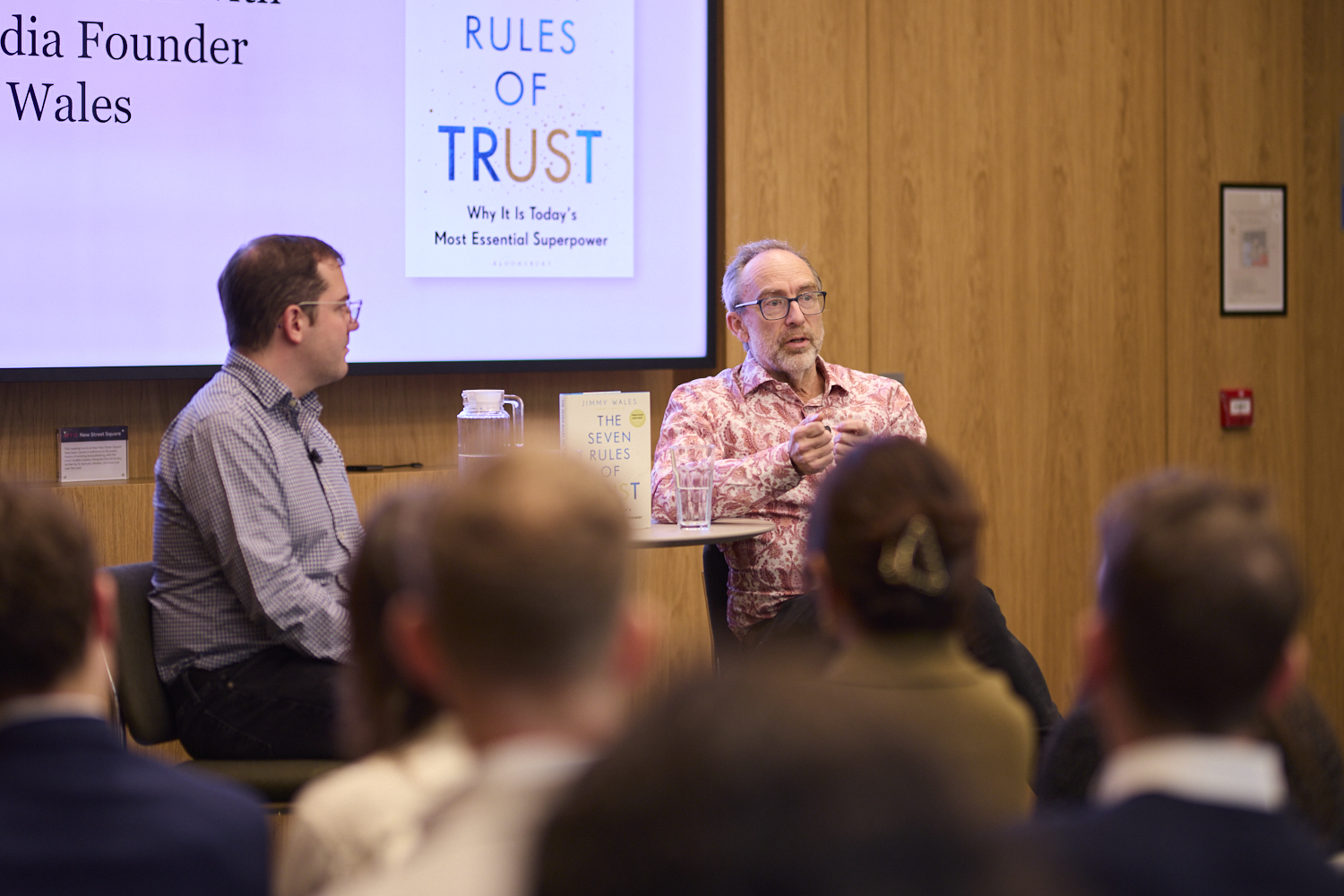
Wikipedia Founder Jimmy Wales joined us in London to discuss the principles behind his new book, The Seven Rules of Trust, and shared the lessons that have guided Wikipedia’s evolution into one of the world’s most influential knowledge platforms. Founded in 2001, Wikipedia is an encyclopaedia powered by an online community of millions of editors, with English Wikipedia currently having over 260,000 active editors. The discussion provided insights not only into the mechanics of online communities, but also into the broader dynamics of credibility, transparency, and reputation.
Key Takeaways
1. Purpose
Jimmy emphasised Wikipedia’s clear purpose: “With Wikipedia, one of the things that’s been very helpful… is that we have a very simple purpose: to create a free, high-quality, neutral encyclopaedia… and that purpose defines everything we do, and defines the work, and defines the rules, and defines everything.” This clarity fosters trust, both within the community and among readers. The platform’s rules, such as “no personal attacks” and a commitment to civility, are designed to maintain a healthy environment, even when disagreements arise. It’s a model, based on modern social media, that shouldn’t work – but it does. It serves as a reminder that every organisation needs a purpose to unify and to work towards.
2. Identity
Reputation serves as a currency on Wikipedia. The more reputable you are, the less likely your contributions will be reverted. In this context, Jimmy highlighted the difference between pseudonymity and anonymity: “There’s a well-known Wikipedian called New York Brad. He’s one of the most respected Wikipedians. I happen to know he’s a partner in a law firm… his name is not Brad... he edits under the same identity. And so, in Wikipedia, your pseudonym is your reputation.” Some social networks centre on anonymity, enabling toxic behaviours without repercussion or resolution. Real identity matters in certain situations, but “… pseudonymity is enough, as long as you’ve got a reputation that builds over time”. This self-regulation has helped Wikipedia to become one of the most reliable information sources on the internet.
3. AI
Generative AI predicts the next token or word based on probability, with a bit of randomness added “… writing the most plausible thing isn’t the same thing as writing the most true thing, and so what you get is hallucinations… Generative AI right now is not good enough to write Wikipedia entries from scratch.” Regarding Elon Musk’s Grokipedia, Jimmy commented, “… it’s pretty much what I would expect… It clearly has a lot of misinformation in it, a lot of hallucinated content.” AI and the need for evidence impact Wikipedia in various ways: ensuring AI-generated content does not negatively affect entries, Wikipedia being used as one of the largest Gen AI sources, and the economics of Wikipedia as a non-profit whose servers are utilised by ‘big tech’ for training their language models.
4. Transparency
For companies, Jimmy’s advice was clear: transparency is key. “Don’t create an account and pretend to be a retired mechanic in Ohio and start editing about your company. Anyway, like, you’re gonna get caught, it’s gonna be bad, it’s gonna end in tears.” Engaging with Wikipedia’s talk pages and providing reliable sources is the best way to correct inaccuracies. Attempts to manipulate content covertly are counterproductive and damage trust.